Meta Can Automate Your Advertising. It Can’t Be Accountable for Your Brand.
Meta’s recent AI advertising problems may look like product bugs. But they expose a more consequential question for marketing leaders: as platforms take over more of the creative process, who protects everything the algorithm isn’t designed to value?


TL;DR
Meta’s recent AI advertising problems may look like temporary product bugs. But they expose a deeper issue.
Platforms optimize clicks, conversions, and efficiency. Brands remain accountable for accuracy, compliance, trust, and reputation.
As AI takes over more execution, marketing teams need to become better orchestrators: defining trusted inputs, protected truths, acceptable transformations, and the decisions that still require human judgment.

A few weeks ago, REI found itself explaining why one of its Instagram ads featured a bicycle with two handlebars.
The company said Meta had automatically enrolled the ad in an AI feature that generated the inaccurate image. Meta, for its part, points out that AI can make mistakes and that advertisers are responsible for reviewing what ultimately runs.
Both explanations can be true. And that is precisely the problem.
Meta is taking on more of the work involved in creating, adapting, targeting, and distributing advertising. But the accountability for what customers see still belongs to the brand whose name appears above it.
The platform controls the machine. The brand owns the mistake.
REI wasn’t alone. Advertisers interviewed by Business Insider described a pajama dress becoming a shirt and pants, a women’s networking organization suddenly featuring men, and carefully photographed products turning into strange imitations of themselves.
The examples are funny until you imagine being the marketing leader who gets the screenshot.
Your CEO sees it. Your customers are tagging the brand. The creative team wants to know who approved it. Legal wants to know what else is running. Your agency is checking campaign settings. Someone is trying to reach the platform representative.
The advertisement may have taken seconds to generate.
The organizational response certainly won’t.
It would be easy to look at these examples and conclude that Meta’s image-generation technology simply isn’t ready. That may be true today, but it is not the most important conclusion.
The models will get better.
The bicycle will eventually have the correct number of handlebars.
The harder problem will remain.
 Lara O’Reilly and Sydney Bradley and Lucia Moses
Business Insider spoke with advertisers who reported altered products, unwanted creative changes, and additional manual oversight associated with Meta’s AI advertising tools.
The real risk isn’t bad creative
Meta is very good at understanding which combination of image, message, audience, placement, and budget is likely to produce a response.
That is what advertisers pay it to do.
But performance is only one part of what a marketing organization is responsible for.
A platform can identify the image most likely to earn a click. It cannot fully understand why a particular product detail matters, which claim survived six weeks of legal review, or why a seemingly harmless creative choice could upset a relationship with a retailer.
- It does not know what your customers have been promised.
- It does not know which internal debate preceded a line of approved copy.
- It does not know what your brand has spent 20 years trying to mean.
More importantly, it is not accountable for any of those things in the way you are.
That doesn’t make Meta irresponsible. It means Meta and the advertiser are operating with different responsibilities.
The platform primarily sees assets, objectives, audiences, and probabilities.
The marketing leader sees the accumulated trust behind the logo.
Most of the time, those interests point in the same direction. Meta wants an ad to perform, and so does the advertiser. But they are not perfectly aligned.
An inaccurate product image might still attract attention.
An exaggerated claim might still improve conversion.
An inflammatory message might still generate engagement.
The campaign dashboard can tell you that something worked. It cannot always tell you what it cost the brand.
That distinction is becoming more important as platforms move beyond distributing creative and begin actively making it.
The accountability gap
There is now a widening gap between what the platform can optimize and what the brand must protect.
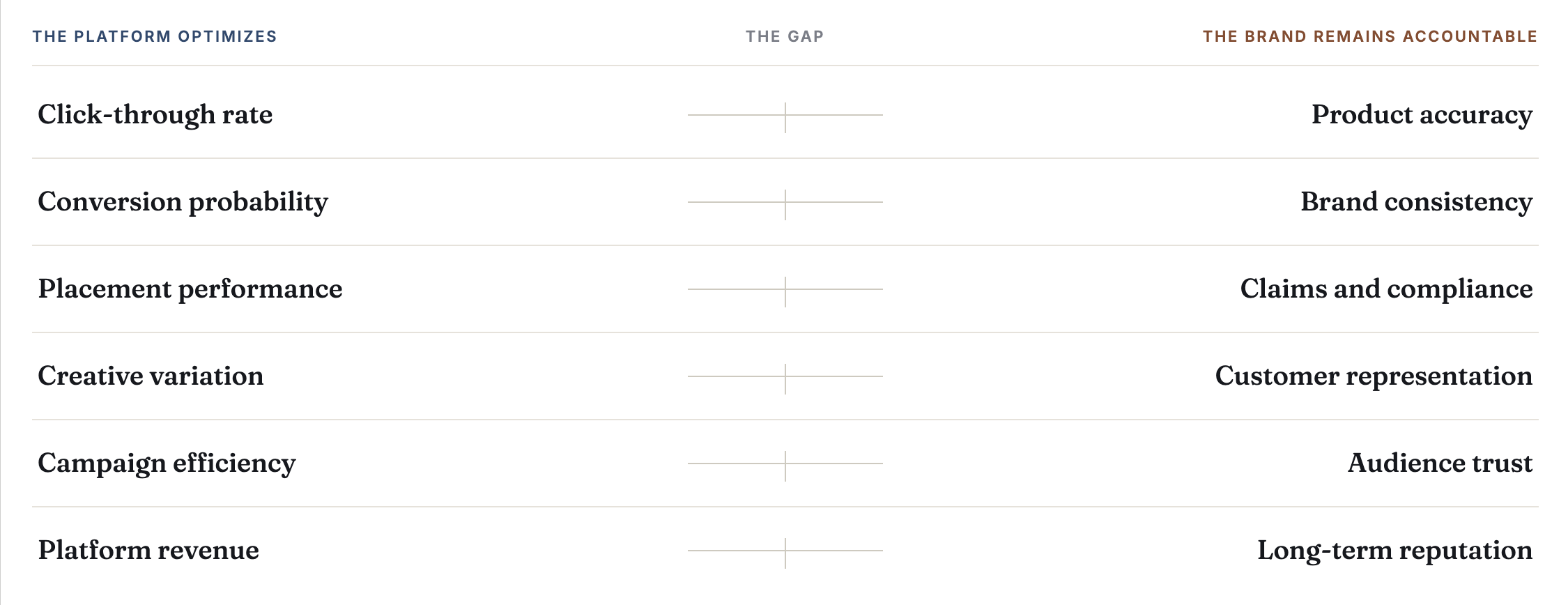
The left side is increasingly automated, measurable, and fast.
The right side is contextual, organizational, and often difficult to quantify.
It includes all the things that rarely fit neatly inside an advertising objective: whether the product is being represented honestly, whether a customer story is being used appropriately, whether a claim is technically permissible, and whether a piece of content feels unmistakably like the brand.
Marketing leaders have always been accountable for the right side.
What is changing is how much of the left side—and increasingly, the creative work connecting the two—is being handed to systems the brand does not directly control.
That is the accountability gap.
It is not a reason to reject platform automation. The performance and efficiency gains are real. But it is a reason to be far more deliberate about where the platform’s decision-making ends and the brand’s governance begins.
When automation creates more work
The promise of AI in marketing is usually framed around capacity.
A team that could previously create ten variations can now create 100. Eventually, it may create 10,000—adapted across audiences, formats, markets, messages, and placements.
That sounds like a straightforward productivity gain.
But every new variation is also a new representation of the brand.
If the organization’s answer is to have a person review every one, the math breaks almost immediately.
Imagine a marketing organization running 20 campaigns in a month. Each campaign begins with ten approved assets. The platform produces 25 variations from each asset.
That is 5,000 creative outputs.
Even if someone spends only 90 seconds reviewing each one, the organization has created 125 hours of additional work—more than three full working weeks.
And 90 seconds is not much time to verify the product, copy, claims, disclosures, crop, context, and overall brand fit.
This is the strange reality many marketing teams are encountering: the technology that promised to remove production work is creating a new layer of supervision.
Teams are checking settings, inspecting variants, documenting approvals, tracking exceptions, and trying to determine which AI features are active across platforms and accounts.
The work has not disappeared. It has moved.
That does not mean automation has failed. It means the operating model has not caught up.
If every automated decision creates another item in a human approval queue, the organization has not truly scaled. It has simply moved the bottleneck downstream.
This is where orchestration matters
I recently heard a marketing leader describe the role she wanted to play inside her organization:
“I want to be the orchestrator, not the executor.”
I wrote it down immediately.
It captures something I have heard repeatedly from CMOs, brand leaders, and social teams—often in different language, but with the same underlying frustration.
They do not want their teams spending every day manually resizing assets, chasing approvals, finding customer content, checking rights, rewriting the same copy, or policing another set of platform settings.
But they also cannot simply hand the brand to a black box and hope the output looks reasonable.
They want leverage without losing judgment.
That is the difference between automation and orchestration.
Automation performs a task.
Orchestration determines which tasks should happen, what inputs are trustworthy, what the system may change, what must remain protected, and when a person needs to become involved.
A resize may be automated.
A new product claim may need to be escalated.
An approved video might be reformatted for a different placement.
A customer’s words should not be changed to make the testimonial more compelling.
An established template might be applied automatically.
An unfamiliar creative direction being deployed across millions of impressions probably deserves another look.
The goal is not to keep a human involved in every decision.
It is to keep human judgment involved in the decisions that carry real consequence.
“Human in the loop” is not an operating model
“Keep a human in the loop” has become the default answer to almost every concern about AI.
It sounds sensible. It is also incomplete.
Which human?
In which loop?
Reviewing what?
At what point?
With what authority?
If the person arrives only at the end to inspect thousands of machine-generated outputs, the organization has turned that person into quality control for an infinitely productive system.
That is not a durable solution.
Human judgment needs to shape the system much earlier.
People must establish the source material the system is allowed to use. They must define which facts and claims cannot change. They must determine what level of transformation is acceptable and which decisions require specialist review.
Then, once content is live, someone needs to know what was published, how it was produced, and when to intervene.
The human role is not simply to catch the machine doing something strange.
It is to create the conditions under which the machine can be useful without being reckless.
Major takeaway: Human review is a task. Human governance is a system.
Seven questions I would ask
Before allowing an AI system or advertising platform to modify creative at scale, I would want the marketing organization to answer seven questions.
1. What can the system build from?
Start with the source material.
Is the system using approved product information? Current pricing? Brand assets? Licensed imagery? Rights-cleared customer content? Public social posts? Synthetic material?
If the organization cannot trust or verify the source, it will struggle to trust the output.
2. What is the system allowed to change?
Not all transformations carry the same risk.
Changing an aspect ratio is different from changing the product. Removing silence from a video is different from changing what a customer appears to say.
“AI-enhanced” is too broad to function as a policy. The organization needs a more precise definition of acceptable transformation.
3. What must remain true?
Some things should never become creative variables.
That might include product construction, ingredients, pricing, approved claims, customer identity, disclosure language, or the meaning of someone’s testimony.
The system needs to know what it is optimizing around—not merely what it is optimizing for.
4. Which decisions require a person?
Not every crop needs executive approval.
A new medical claim might require legal, regulatory, and brand review. A routine format conversion may require none.
Review should be based on consequence and uncertainty, not applied uniformly to every output.
5. Can we reconstruct what happened?
If an advertisement causes a problem, can the organization trace it back to the original asset?
Can it identify the transformations that were applied, the permissions attached to the content, the person or system that approved it, and every channel where it appeared?
Without traceability, accountability becomes an investigation.
6. Who can stop the system?
Someone needs the authority to pause distribution, remove an asset, escalate a concern, and investigate unexpected behavior.
If everyone is vaguely responsible, no one is operationally accountable.
7. What are we measuring besides performance?
Clicks and conversions matter.
So do accuracy, complaints, brand consistency, customer sentiment, rights compliance, and long-term trust.
If the system can only see what is easy to count, it may optimize away something the organization never thought to include in the objective.
Major takeaway: AI governance becomes practical when the organization defines trusted inputs, permitted transformations, protected truths, decision rights, traceability, accountability, and broader measures of success.
What I would do next
For a CMO or VP of Marketing, I would not begin with a 50-page AI policy.
I would begin with five practical steps.
1. Inventory what is already active
Document which platforms, agencies, teams, and tools can generate or materially alter brand content.
You may discover that more automation is active than leadership realizes.
2. Define protected truths
Identify product attributes, approved claims, disclosures, customer statements, and brand elements that AI may not modify.
3. Separate routine changes from consequential ones
Resizing an approved asset and creating a new product claim should not travel through the same approval process.
4. Assign intervention authority
Name the people who can pause automated distribution, remove content, and escalate an exception.
5. Run one live audit
Select a meaningful campaign and trace several published assets back through their sources, permissions, transformations, and approvals.
The gaps will become visible quickly.
Major takeaway: Do not wait for the perfect enterprise governance framework. Start by making current automation visible and defining what the system must protect.
The answer isn’t less AI
I do not believe the lesson from Meta’s recent problems is that marketing organizations should avoid AI.
The benefits are too meaningful, and the direction of travel is already clear.
AI will play a growing role in evaluating, editing, adapting, distributing, and measuring content. It will allow smaller teams to accomplish work that previously required large internal departments and agency networks.
But more capable models will not eliminate the need for marketing leadership.
They will change where leadership is most valuable.
When execution becomes abundant, judgment becomes scarce.
The advantage will not belong to the organization that produces the most variations. It will belong to the one that knows which inputs to trust, which decisions to automate, which truths to protect, and where people still need to be accountable.
The future of marketing is not a choice between people and AI.
It is a choice between poorly governed automation and intelligently orchestrated participation.
The machine can execute.
The platform can optimize.
But neither can be accountable for what your brand means.
That still belongs to you.
About Scale Social AI
Scale Social AI is building authenticated content infrastructure for enterprise brands.
We help organizations capture real human experiences, secure the necessary rights, preserve traceability, and use AI to evaluate, enhance, distribute, and measure content without manufacturing the underlying truth.
[Learn more about Scale Social AI →]
New here?
Earned, Not Bought is for marketing leaders navigating AI, authentic content, social operations, and the future of brand building.
Join CMOs, brand leaders, and social teams receiving original perspectives and practical frameworks from Scale Social AI.